

“Sustainability”, from a lighting viewpoint within one of the top universities in Vietnam – Ton Duc Thang University
Rethinking how we design and use light to minimize environmental impact, optimize energy efficiency, and promote long-term well-being for both people and the planet. Through education, innovation, and collaboration, the university is defining future designers to consider the ecological and young generation designer role of lighting in creating a sustainable built environment.
Over the past three years, kobi lighting studio and Ton Duc Thang University (TDTU) have nurtured a thoughtful and forward-looking collaboration through the initiative “Dream for Light.” This long-term partnership reflects a shared commitment to cultivating awareness, creativity, and responsibility in the next generation of designers and urban thinkers. Most recently, this vision was brought to life through an intensive workshop series titled “Rethinking Sustainable Lighting Design for Resorts,” hosted at TDTU in Ho Chi Minh City. These sessions brought students face-to-face with the realities and potential of sustainable lighting, not as a technical afterthought, but as a vital part of human-centered and environmentally responsible design. The workshops offered both a theoretical foundation and practical tools, empowering students to think critically about the intersection of light, space, and sustainability.
Workshop 1: What is Light? A Foundation for Intentional Design
The first workshop began not with fixtures or technical specifications, but with a simple, profound question: What is light? In exploring this, students were invited to understand light as more than illumination. Light was positioned as a material that touches everything, mood, health, perception, rhythm, and ultimately shapes how people feel in a space. The objective was to establish a deep understanding of light’s impact on human well-being and the environment, particularly in the context of resort design where comfort, tranquility, and sensitivity to nature are paramount. Students engaged with foundational lighting principles, such as Correlated Color Temperature (CCT), and how different temperatures affect emotional and physiological states. They also explored the consequences of light pollution, not just its impact on the sky or wildlife, but on the spirit of a place and its ability to provide peace and rest.
The workshop moved from theory to hands-on exploration. Students conducted experiments using a variety of light sources. Armed with light meters, they were challenged to guess the color temperature of each source. What emerged was more than accurate answers; it was evidence of developing sensitivity. Students were not just learning to measure light; they were learning to feel it. Through this experiential learning, they gained confidence in their understanding of how lighting choices can enhance or detract from the human experience.
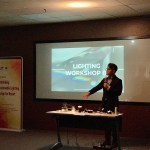

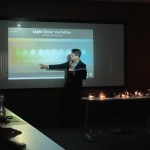
Through practical examples, we have conveyed “key” lighting knowledge to the students.
Workshop 2: Redesigning Lighting for Sustainable Resorts – A Case Study in Pathway Illumination
The second workshop expanded on these ideas by taking students into a more complex, applied design scenario: how to rethink pathway lighting for resorts in a sustainable, guest-centered way. Resort design is not limited to rooms and interiors; it begins long before a guest steps through the door. Often, the first impression is formed during arrival, an experience that can be shaped, for better or worse, by the presence and quality of exterior lighting. This session challenged students to see streetlights not as background infrastructure but as powerful tools for storytelling and ambiance.
The problem presented was clear: excessive and poorly designed lighting can not only disrupt the serenity of a resort but also impact local ecosystems. With that in mind, students studied lighting regulations from both Vietnam and France to understand how policy frameworks guide sustainable lighting decisions. They then applied this knowledge to reimagine resort pathways, spaces often overlooked, yet critical to a guest’s emotional journey. Working in groups, students created physical models of resorts and developed lighting schemes that embraced both functionality and environmental care. Their designs considered questions such as: How do we guide a guest safely through a space without over-lighting it? How can lighting support a sense of calm and welcome rather than overwhelm?
The outcomes were inspiring. Each group offered a unique interpretation, proving that there is no one-size-fits-all solution to sustainable lighting. What they shared, however, was an intentional mindset, one that recognized lighting as an active part of creating meaningful, memorable, and responsible spaces.
From the initial stages of getting acquainted and experimenting with various lighting designs to becoming true “lighting designers” through their own sustainable streetlight design.
Conclusion: Guiding the Next Generation of Lighting Designers
These workshops demonstrated that lighting design is far more than a technical discipline; it is a deeply human practice. Students walked away with more than terminology or techniques; they left with a new way of thinking. They came to see that lighting shapes how we feel, how we rest, and how we connect to the world around us. It affects not just buildings, but ecosystems, and the emotional landscape of a place. Most importantly, they began to realize that sustainable lighting requires designers to think holistically, not just about fixtures or brightness, but about experience, context, and legacy.
kobi lighting studio encouraged students to think beyond the immediate site of a resort. Sustainable design is never isolated; it exists in relationship with nature, with regulation, and with the community. Even a streetlight can be a symbol of a more thoughtful world, one where lighting doesn’t overpower, but supports and enhances the rhythms of life.
Celebrating the two winning groups of the workshop: “Becoming a Lighting Designer”
A Continuing Collaboration
This series marks just one chapter in the growing partnership between kobi lighting studio and Ton Duc Thang University. Both institutions are committed to continuing this journey, cultivating the next generation of lighting designers, architects, and urbanists who will contribute to the cities and spaces of tomorrow with care, intelligence, and creativity. Through workshops, mentorship, and future joint projects, the Dream for Light initiative aims to light not only spaces but also minds, with a vision for a brighter, more sustainable, and more beautiful world.
Visit our previous lighting workshop at Ton Duc Thang University: https://kobistudio.com/into-the-night-lighting-masterclass-kobi-shares-lighting-knowledge-and-expertise-with-urban-planning-students/